Showing posts with label baby activities. Show all posts

Friday, 20 June 2014

30+ Activities for 4th of July + $1500 Cash Giveaway!

I am very excited to bring you today's post! It will be huge, but I have it broken down into 3 parts:

1 - First, I have collected over 30 ideas for 4th of July activities to do with your kids, including very creative arts & crafts, Montessori activities, Free Printables, Sensory Activities, and Book Lists with the best patriotic books to read with your kids.

2 - After you look at all these activities and you scroll down, you will have a chance to enter the Kid Blogger Mega Cash Giveaway! I have teamed up with a group of amazing kid bloggers to bring you 3 prizes of $500 each. This means we are giving away $1500 cash! Wow! To enter the giveaway, you will have the option to follow each participating blogger via facebook, pinterest & twitter, and the more bloggers you follow the more chances you have to win the prize!

But wait, there's more!

3 - After you enter the giveaway, all the way to the bottom you will see a Link-Up of all the participating bloggers' round-up posts (like this one!) on a huge variety of different topics. This will be a great resource for you, so please check out as many as you can!

Here we go!

30+ Activities for 4th of July

Arts & Crafts

Fireworks in a Bottle by No Twiddle Twaddle

4th of July Crafts for Baby by House of Burke
 
Super Easy 4th of July Wreath by No Time for Flash Cards
 
Letter of the Week (Flag F) by No Time for Flash Cards

4th of July Craft by Loving My Nest

Firework Painting by Juggling with Kids
 
Easy Jar Candle Craft by Fantastic Fun and Learning

Color Rice American Flag Exploring by Powerful Mothering

Salt and Glue Fireworks by School Time Snippets

Patriotic Hand Print Craft by B-Inspired Mama

Fourth of July Crepe Paper Flag Craft by Meaningful Mama
 
American Flag Collage by Meaningful Mama


Montessori Activities


Red, White and Blue Tot Trays by Fantastic Fun and Learning


Free Printables


4th of July I Spy Game by The Pleasantest Thing
 
Free 4th of July Pack by 3 Dinosaurs


Sensory Activities

4th of July Activity: Make Slime by The Pleasantest Thing
 
Shaving Cream & Paint Fireworks by No Time for Flash Cards


4th of July Fun with Water Beads by I Can Teach my Child

Fireworks Play Dough by Fantastic Fun and Learning


Books Lists

 
 Best Fourth of July Picture Books by Ready-Set-Read!

Patriotic Picture Books for 4th of July by No Time for Flash Cards


 And now for the Giveaway!! ENTER BELOW!

 
Win one of three $500 cash prizes directly in your paypal account! This giveaway is open internationally. You must be 18+ years old to enter. Void where prohibited. No purchase necessary. Winners will be notified via email and have 48 hours to respond before another winner is chosen. Please see detailed terms and conditions below the giveaway for more info.

a Rafflecopter giveaway

Link - UP

And Now for a HUGE Link-Up of other Kid Blogger's Posts who are also Hosting the Cash Giveaway. These are the same bloggers you'll be following if you enter the giveaway, so check out their awesome stuff!

Friday, 28 February 2014

Painting Activity for Babies

Baby Finger Painting
This post contains affiliate links. Thank you for your support.

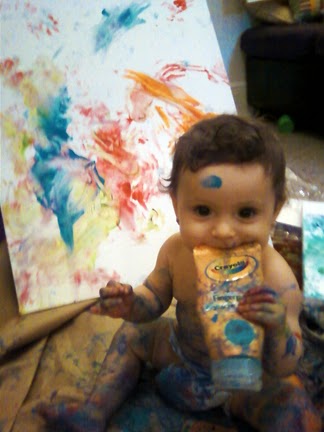
Finger painting with babies might start out with fingers... but it can quickly turn into full body painting! Yes, this may seem very messy (and it is!) but the end result is a masterpiece that you can hang on your wall and your guests will think it's a modern art piece you bought at the gallery. Well, maybe not quite.. but you'll have some great wall art for your kid's room.

When my daughter was 8 months old I started painting with her. I placed an old sheet on the floor to contain the mess, then I laid down one of my large canvases. I squirted some finger paint on the canvas, one color at a time, and she eagerly went to work. She started spreading the paint around the canvas with her fingers, then proceeded to crawl all over the painting and use her whole body as a paintbrush. The result was impressive!

Baby Finger Painting
 
Baby Finger PaintingPainting made by baby
 
Baby Finger PaintingBaby Finger Painting

Tips:
1: Make sure your child is at least 6 months old and is able to sit up on their own. If your child does not crawl yet you can rotate the canvas for them or place the child on different parts of the canvas. If your baby is crawling, let them crawl all over the painting. It might seem like the canvas is bending or caving in, but it should snap back into place later.

2: My daughter started out in a t-shirt onesie but I quickly learned that it was much easier if she paints without any clothes, just a diaper. This makes it easier to quickly place her in a bath right after the activity. Also, the diaper actually creates some interesting designs when it is dragged across a painting!

3: Start by squirting one color on one part of the canvas. Let the child finish spreading that paint around. Then squirt another color somewhere nearby and let the child work on that. Keep doing this until the painting is complete.

4: Let the child complete the painting at their own pace - some babies might be done in 5 minutes and decide to crawl away in search for the next adventure, while other babies might sit and paint for quite a while.

5: You may know from experience that complementary colors (colors that are opposite each other on the color wheel. example: red & green, blue & orange, yellow & purple) will turn a lovely shade of brown when combined. In order to keep the painting bright and colorful and minimize brown areas try to avoid using complementary colors next to each other.

6: Yes, babies put everything in their mouth. These Crayola finger paints are non-toxic, but if you prefer you can make your own homemade finger paints with this simple recipe.


Tuesday, 5 November 2013

Teaching Tools for Babies


Research shows that the first five years of a child's life is the most critical period for brain development. In this period, brain cells make connections that lay the foundation for all future learning. These pathways must be maintained, through repetition and consistency, in order for the connections to be preserved. The network of connections influences intellectual capacity, memory, problem solving, and language. Most of these connections are made in early childhood, especially in the first year of life.

Starting from birth, the most important thing a parent can do is to interact with their baby as much as possible. You are your child's best teacher. A baby's brain is designed to learn best from human interaction. Experts recommend talking to your baby a lot. The more that a baby hears the patterns of language, the easier language learning becomes. By age 3, kids spoken to more frequently have an IQ that's 1.5 times higher than that of children who weren't. By the time they're in elementary school, they have much stronger reading, spelling, and writing skills. You should narrate your day, meaning talk about everything you are doing and everything that is happening. Once your baby starts babbling, you should have "conversations" with the baby. Ask the baby a question then pause and wait for a reaction. This kind of interaction will help to develop social and emotional skills. It is also recommended that parents read to their child every day, starting from birth.

Infant Stimulation Cards (newborns - 5 months):

Because vision is one of the least developed senses at birth, it is a good idea for the parent to offer stimulating images to aid in the baby's development. At birth, a baby’s retina is not fully developed. An adult retina can distinguish many different shades of light and color, but a newborn retina can only detect large contrasts between light and dark, or black and white. I used to notice my baby staring at high contrast objects such as the dark framed mirror or the dark curtains up against a white wall.

Infant stimulation cards are black and white patterned cards that you hold up in front of your baby as a visual stimulation tool. Research shows that infant stimulation cards will help calm and soothe your baby as well as increase concentration skills, enhance natural curiosity and stimulate the creation of brain cell connections. You can download 10 free infant stimulation cards,
click here! The best distance to place the card is 8 to 12 inches from your baby's eyes. You can tape it to the side of the crib, the wall next to the changing table, in front of your car's baby seat, or just show it to your baby and let the baby look at it until he loses interest. These cards are good for newborns up to around 5 months. Make sure baby is alert and active while showing these cards.


Infant Stimulation Cards Free


The file contains 2 cards per page, you can laminate them and make 10 cards or 5 double-sided cards.

Baby Flash Cards (5 months and up):

Once your baby starts to stay awake and alert for longer periods, around 5 months, a daily exercise you can do is to use flash cards to aid learning. You can download free alphabet flash cards A-Z and numbers 1-10,
click here! These high contrast black and white images are best, and you just want to flash each card for a second while saying the letter sound. This exercise should last no longer than a minute for the whole set of cards. Do this while your baby is alert and in a high chair or seat. Consistency is the key, so if you do this every day you will significantly impact your child's reading potential. The child will quickly learn the letter sounds which is the first step in learning to read phonetically. Give your baby a head start in reading!

Your baby will also learn to recognize numbers by using the number cards. You should also try to count things in every day conversation. Count the baby's fingers and toes, count the number of steps in your staircase, etc. Soon the baby will be counting everything too!

Note: Teaching your infant with flash cards should not be time consuming and should always be fun. To be used in addition to lots of meaningful interaction and play with your baby. If your baby is not interested, try again at a later time. Also, if you do not start at 5 months, don't worry it is never too late to start. Your child will benefit regardless.


Baby Flash Cards Free

The file contains 6 cards per page, just laminate and cut out. You can also hole punch and put them through a ring to hold them together and quickly flip through them.

Baby Flash Cards Free


Baby Learning Flash Cards


Baby Learning Flash Cards